The Pitch Express
send your first pitch in 4 weeks
Stop Thinking “I’d Love to Write for Magazines and newspapers” — And Send Your First Story Pitch to a Real Editor
🔒 100% Secure 256-Bit Security Encryption
A practical four-week course that takes you from wondering, 'what could I write about?', to developing an editor-ready story pitch. Putting you on the path towards seeing your own byline in a publication you’d love to write for.
If you love writing and regularly read magazines, newspapers or online publications thinking “I’d love to do that” or “I could write something like that”, The Pitch Express shows you how to stop wondering and start pitching.
Maybe it's something you'd like to try for personal achievement or professional kudos!
Because seeing your name on a published story starts somewhere.
It starts with giving an editor a story to say yes to.
You don't need a journalism degree.
You don't need a little black book of editor contacts.
And you don't need a portfolio bursting with published articles just to get started.
You need to know how to find a story worth pitching, work out where it belongs, develop the angle and put your idea in front of the right editor.
The Pitch Express teaches you how to develop and send a considered,
professional pitch.
Inside The Pitch Express you'll learn how to:
Spot potential stories in the things you notice, experience, read and wonder about.
Find the right publication for your idea.
Turn a broad topic into a specific story with an angle.
Build an editor-ready pitch without writing the entire article first.
Find the appropriate editor and hit send.
Know what to do next if the answer is yes, no... or silence.
You'll get instant access to 8 focused, short, video lessons, practical tasks, worksheets and practical pitch building resources, plus 10 examples of real pitches that were commissioned.
JOIN NOW FOR $39
Join The Pitch Express For $39
Get Full Access Right Away.

🔒 100% Secure 256-Bit Security Encryption

you know you can write so what's stopping you from pitching?
Perhaps you've been reading magazines and newspapers for years. Or would just love your byline in a newspaper, magazine or online platform for personal or professional satisfaction.
You notice things. You're interested in people. You have opinions. You travel, read, follow the news or find yourself wondering about things other people barely notice.
Every now and then you read an article and think:
“I could write something like that.”
But you don’t have a clue where to start or if it’s even possible and you come up against a wall of impossible questions, like:
What would I actually write about?
Is my idea really a story?
Hasn't someone already written about it?
What's my angle?
Which publication would want it?
Do I need to interview people before I pitch?
What exactly do I put in the email?
Who do I send it to?
And perhaps the biggest question of all:
Why would an editor take me seriously?
So you don't send anything.
You tell yourself you'll look into it when you have more time.
Or when you've got a better idea.
Or when you know more about journalism.
Or when you feel a little more qualified to call yourself a writer.
Then another month goes by.
Then you read another story and think:
I could have written that.
The Pitch Express will take you from...
"I'd love to write for publications."
to
"I've just sent an editor my pitch."
Four weeks from now, instead of still wondering how people get stories into publications, you could have gone through the process yourself, and have your pitch sitting in a real editor's inbox.

there is a route from : "I have an idea"... to "I've sent my pitch"
That's why I created The Pitch Express.
It's a practical, four-week pitching course designed to help aspiring publication writers move through four essential stages:
SPOT THE STORY → FIND THE FIT → BUILD THE PITCH → FIND THE EDITOR & HIT SEND
Instead of spending hours learning about freelance writing in theory, you'll work on your own ideas, publications and pitch as you go.
Week 1 - Spot the Story
Learn where story ideas actually come from and start identifying possibilities in your own experiences, observations, questions, interests and everyday life.
Use the Story Spark exercises to start recognising potential stories rather than waiting for inspiration. Look at 10 successful pitches, see where the idea came from and read the published story.
Week 2 - Find the Fit
Learn to read a publication like a potential contributor, not just a reader.
You'll investigate what it publishes and what its readers care about, that fits the publication. Move from a broad topic to a particular story and then sharpen your angle.
Week 3 - Build the Pitch
Work out whether you have enough of a story, look at your idea from an editor's point of view and use the Pitch Builder to start constructing the actual pitch you'll send. Use the pitch builder, checklists and 10 real pitch's that got commissioned resource, to turn the pieces into a clear, professional pitch.
Week 4 - Hit Send & Know What Comes Next
Make your final checks, identify the appropriate editor and send your pitch.
Then learn what to do when an editor says yes, says no—or doesn't reply at all. Track your pitch, follow up appropriately and decide whether an unsuccessful idea should be reworked, reframed, retargeted, or retired.
Everything is available immediately, so while the course is designed as a four-week pathway, nothing is drip-fed. If you've already got an idea or simply want to move faster, you can.
and you'll see how pitches work in the real world
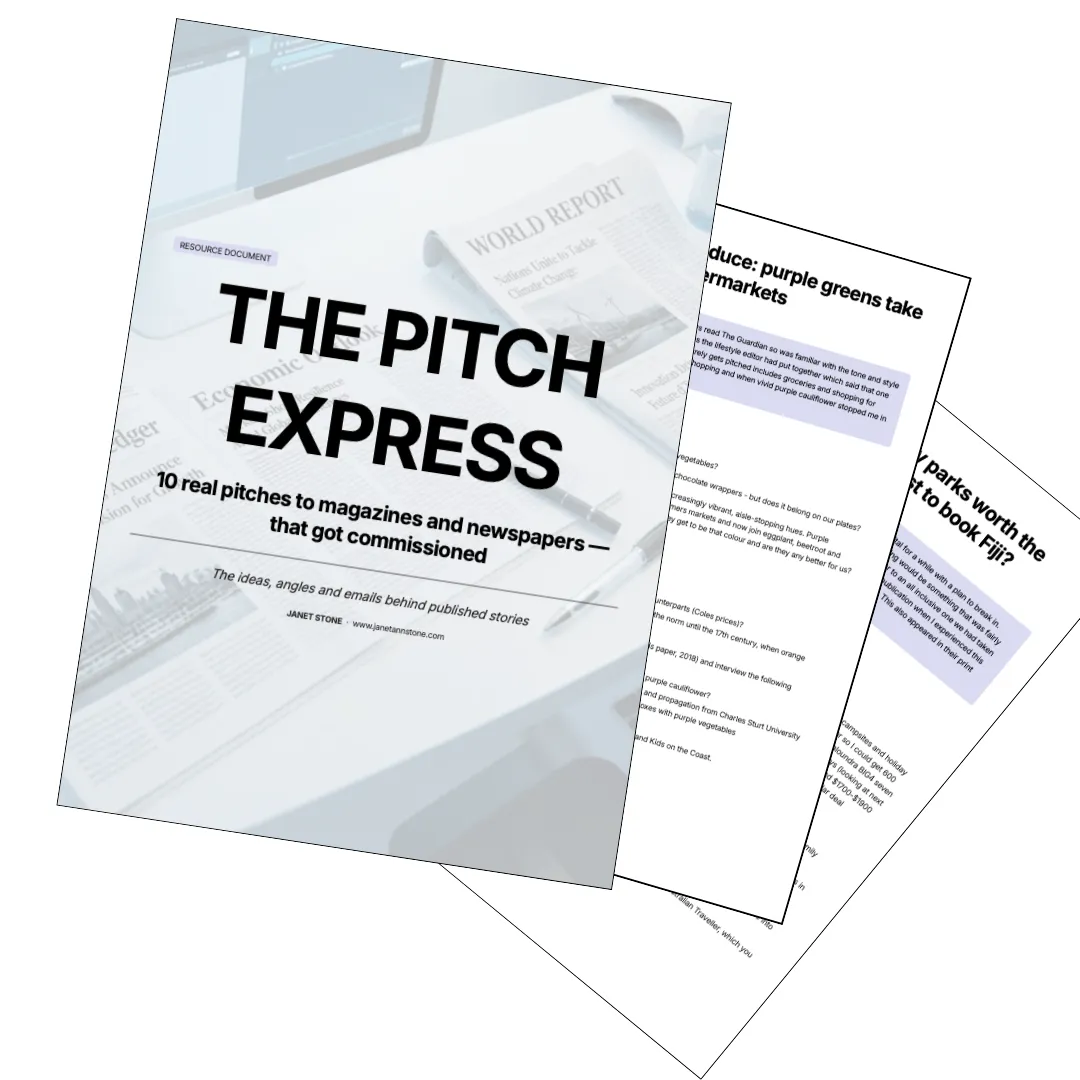
One of the most useful things you can see when you're learning to pitch isn't another theoretical template.
It's what actually happened.
Throughout The Pitch Express, I use examples from my own work to show you how ideas developed and what happened when I took them to editors.
Clearly showing you how the process of curiosity becomes a story. How a story becomes an angle. And how an angle becomes a pitch.
How I started out
I’m Janet Stone, a freelance writer, content strategist and the creator of The Pitch Express.
I started pitching in 2019 and since then I’ve turned ideas, interviews and expert knowledge into stories that people want to read. My work has appeared in publications including The Sydney Morning Herald, The Australian Financial Review, The Guardian, The Saturday Paper, MiNDFOOD Magazine, Reader’s Digest, Escape, International Traveller, and Sunday Paper supplements - The House of Wellness, Explore Travel and Escape.
I know that pitching an editor can feel intimidating, especially when you’re unsure whether your idea is strong enough, who to contact or what to write in the email. But pitching isn’t a mysterious skill reserved for established journalists. It’s a practical process you can learn.
I created The Pitch Express to share the process I use to spot story ideas, find the right publication, develop a compelling angle and write a focused pitch. My aim is to help you stop second-guessing your ideas and send an editor a pitch you’re proud of; within four weeks!
I spent years working in communications and marketing.
I loved writing and was an avid reader of newspapers and magazines. But for a long time, it simply hadn't occurred to me that I could come up with my own story ideas and pitch them directly to editors.
I did a deep dive into the process, stalked a few people that had done it, then started doing it.
Over time, some of those relationships have even reached the point where editors approach me with assignments.
It all started with learning how to pitch.
Four weeks from now, you could still be thinking about pitching...
...Or you could have sent one.

X You don't need dozens of story ideas.
X You don't need to decide whether you're going to become a
freelance journalist.
X And you don't need to map out an entire writing career.
You need:
One Story.
One appropriate publication.
One editor-ready pitch.
The Pitch Express gives you:
8 focused video lessons.
A practical four-week pathway from idea to pitch.
Guided implementation tasks - using your own story.
Worksheets, checklists and pitch-building resources.
Real examples from successful pitches.
Instant access to everything.
You can't control whether an
editor says yes.
But you can stop letting, "I'd love to do that someday" be where this story ends.
NOW FOR ONLY $39
Join The Pitch Express
For $37
Get Full Access Right Away.

🔒 100% Secure 256-Bit Security Encryption
Frequently asked questions
What if I've never been published?
That's fine. Everyone with published work once had no published work to show. We'll look at other ways to answer the editor's implicit, 'Why you?' question when considering your pitch. Including relevant experience, first-hand knowledge, access, research, groundwork and appropriate writing samples and I'll share a couple of insider ways to get your story over the line with no experience.
What if I don't have an idea yet?
That's what Week 1 is designed to address. You'll complete a guided Story Spark Exercise to start uncovering the possibilities.
What if I already have an idea?
Bring it with you. You can use the course to test the story, develop the angle, identify a suitable publication and build your pitch.
Do I need journalism qualifications or editor contacts?
No. Neither is a pre-requisite for sending a pitch.
How much time will it take?
The main guided exercises take approximately 3.5 hours, spread across the four weeks, plus the time you choose to spend developing, researching and refining your particular story.
In other words: Your pitch is your homework.
Do I have to take four weeks?
No. You'll get instant access through CourseiQ to all videos, tasks, worksheets and resources.
Four weeks is the recommended pathway, with two lessons a week, but its possible to undertake all the work in a single week or 8 weeks, depending on how much time you have.
Will my pitch definitely be accepted?
No, and I'd be wary of anyone who promised you that.
Editors decide what they commission.
The goal of The Pitch Express is to help you do the part you can control: develop an appropriate story idea, build a considered pitch, get it in front of the right person and know what to do afterwards.
Is this just for Australian publications?
No. The same principles apply for Australian, UK and US based magazines, newspapers and online platforms.
Is this only for magazines?
No. The principles can apply to suitable magazines, newspapers and digital publications.
Here's Everything You Get
When You Get Access To The Pitch Express Today

Week 1: Spot The Story
$69
Recognise the difference between an interesting topic and a potential story
Find ideas in your experiences, interests and everyday life
Identify the question, tension or change that makes an idea worth exploring
Build a bank of possible ideas so you’re not starting from a blank page
The result: You finish Week 1 with potential story ideas you can begin developing.

Week 2: Find The Fit
$79 Value
Read a publication like a writer rather than simply a reader
Understand its audience, tone, sections and preferred story formats
Find a fresh and relevant angle
Check whether your story has enough substance to support a pitch
The result: You have a focused story idea developed for a publication that could genuinely be interested in it.

Week 3: Build The Pitch
$89 Value
Present your angle clearly and concisely
Explain why the story matters now
Show why it belongs in your chosen publication
Include the information an editor needs to make a decision
Introduce yourself and your experience with confidence
Draft a professional pitch without writing the full article first
The result: You finish Week 3 with a complete pitch draft ready to refine and send.

Week 4: Find The Editor & Hit Send
$69 Value
Research the most appropriate editor or contact
Find and verify useful contact information
Write a clear subject line and professional email
Complete a final check before sending
Follow up appropriately if you don’t receive a response
Keep pitching even when an idea isn’t accepted the first time
The result: By the end of Week 4, your pitch is out of your drafts folder and in an editor’s inbox.
Total Value: $396
Normal Price: $297
TODAY'S SPECIAL PRICE:
JUST A$39
You Save: $357
100% Secure 256-Bit Security Encryption

Copyright © 2026 Janet Ann Stone | All Rights Reserved
Privacy Policy | Terms of Service